
Manipulation in a relationship: five years of not trusting myself
Petra Pinjuh shares her personal experience of manipulation in a relationship and how she gradually stopped trusting her own feelings.
There is a question I hear more and more often: “Do you think my partner is a narcissist?” Friends show me messages they have exchanged with their partners, recount their latest argument and ask me to assess the person they share their life with. Is he manipulative? Is he emotionally unavailable? Is he a narcissist? A psychopath? Petra, look at these messages. What does he mean by this? As though the answer will change how they feel every day. It won’t. It never does. It only makes things more confusing.
Open any news site, social media platform or podcast and you’ll soon come across content explaining how to recognise a narcissist, gaslighting, emotional manipulation or “red flags”. We have never had more knowledge about toxic relationships. And yet I have never met so many people who stay in them because they have started looking for proof that, realistically, they will never find in black and white. It made me wonder: have we perhaps been going about this entirely the wrong way?
How the manipulation began
Here it is extremely important to recognise and stress that manipulation almost never starts with shouting. It starts slowly, with apparent care, conditions and calculation. Until you get used to it. I was a student when I met the young man I would spend almost five years with. Today, with distance and after hundreds of conversations with clients, I can say very clearly that the red flags were there from the beginning. One of the first suspicious moments came just a few days into our relationship.
After a lecture, I sat down for coffee with a male classmate. We talked about exams, study notes and all the things students talk about. Before that, I had messaged my then-boyfriend to say I was having coffee and that we would talk later. About ten minutes later, he appeared outside the café, carrying a little bouquet of flowers. At first glance, romantic and thoughtful. But it was his first attempt to mark his territory. He hadn’t come for me. He came so the other man would see that I was taken.
I remember something in me pausing at that moment. I couldn’t explain what, but something felt strange. Today I know it wasn’t a romantic gesture. I can see now that I ignored my own feeling. But when you are in a relationship like that, it isn’t always easy to recognise what is happening or to trust yourself. Intuition is very quiet; it literally whispers. And we would like it to shout, draw us a picture, even hit us, so we can be sure we aren’t imagining things.
The first two years of that relationship were filled with jealousy, having to prove myself and constant second-guessing. Every time I went out, every conversation, every glance became a subject for an argument. I was young, stubborn and certain that nobody was going to tell me how to live. I thought I had the upper hand every time I answered back. When I defended myself. When I proved he was wrong. Today I know I wasn’t winning; I was just getting more and more tired. In relationships where you have to defend yourself every day, you slowly run out of strength.
And an exhausted person begins to accept things a rested person never would. That’s what happened to me, not overnight, but slowly. I started watching what I said until I stopped speaking. Watching how I dressed until I lost the desire to make an effort. Then I started watching whom I contacted and who might look at me in the street. Eventually, I walked with my eyes on the ground.
If a man I didn’t know looked at me as he passed, even if I hadn’t noticed him, I felt guilty. Because the person walking beside me would make sure I did. Today that sounds unbelievable! But at the time it felt normal.
And that is exactly what manipulation does to a person. It changes your definition of normal. The hardest moments for me to remember now are those when I had seen with my own eyes that something wasn’t true. I knew what I had seen. I was completely sure of myself, of my own eyes! And then the attempts to convince me otherwise would begin. Conversations full of persuasion and twisted truths: “You saw it wrong, you’re imagining things again, you’re not normal.” And so it would go on for three days, four, five… until I was so tired that I no longer had the strength to trust myself.
That is why today I never ask people, “How did you end up in a relationship like that?” I ask them, “When did you first stop trusting yourself?” Because the answer to that question almost always marks the beginning of it all and offers a different way of looking at the whole relationship.
Leaving the relationship
One morning I woke up and stopped trying to save our relationship. I started saving myself. In the end there was no huge argument or dramatic departure. I looked at the man I had spent almost five years with.
I simply told him, “I don’t love you anymore.” He was shocked. I wasn’t. Because that sentence hadn’t come into being that morning. It had been forming for years.
Of course, he didn’t accept my answer. He tried to talk. To persuade me. To bring things back to the way they were. But for the first time in five years, I didn’t feel the need to convince anyone. I didn’t defend myself or explain. My sentences were short, calm, clear. One of the last things I said to him was: “I don’t love you. And I’ll keep saying it until you finally hear me, and if I have to, I’ll draw you a picture.”
That was the end of our relationship. But only today do I understand that it was my beginning. People often ask me now how I knew it was over. I didn’t. But I knew I no longer wanted to live a life in which I had to prove my worth every day. And today, after all these years of working with people, there is something I am absolutely certain of. Nobody can live your life for you.
A psychologist, therapist or friend can offer you knowledge, tell you a sad or encouraging story, explain what manipulation is, how attachment develops and why we stay in a bad relationship. But the decision to stand on your own side again is one you have to make yourself.
If you feel afraid or unsafe in your relationship, you don’t have to go through it alone — reach out to someone you trust or a professional support service.
The wrong question
We often try to understand why someone humiliates us, while finding it increasingly difficult to understand what is happening to us and why it is hard to leave. That is why I think we are asking entirely the wrong question. We shouldn’t be asking, “Is my partner a narcissist or a manipulator?” We should be asking, “How do I feel when I’m with him?” The answer doesn’t require a degree in psychology or psychiatry, or dozens of professional or semi-professional books. It doesn’t require hours on the internet or the opinions of friends. It only requires honesty with yourself.
If every day you feel smaller than you are, if you walk on eggshells to avoid another argument, if you apologise for things you didn’t do, if you no longer say what you think, if you hide your achievements so you won’t provoke the other person, if you have lost your smile, your friends or parts of yourself, then it doesn’t matter what we call the person standing opposite you.
Even if tomorrow you received official confirmation that your partner isn’t a narcissist, but a deeply insecure person, an emotionally immature man or someone who simply doesn’t have the capacity for a healthy relationship, what would actually change? Would your self-confidence come back? Of course it wouldn’t.
Why is it hard to leave?
I believe the greatest tragedy of a bad relationship doesn’t happen the first time someone humiliates you, because there is still room to make a decision then, but the first time you doubt your own feelings. When you believe their words more than your own eyes. When you start thinking, or become convinced, that you really are overreacting. That perhaps you’re too sensitive, that perhaps you are the problem.
One of the most important theories in modern relationship psychology is attachment theory. It explains that we carry the first relationships we form in childhood with us for much longer than we think. They become a kind of model through which we later unconsciously assess what love is, what closeness is and what we can expect from other people.
If, as children, we had to guess when we would receive attention, if love came and went, if we had to be “good” to be accepted or were constantly trying to earn someone’s approval, we may grow up believing that love has to be a struggle, that we have to work harder for it than for our own peace, that it is normal to wait for the other person to change, or that love is something we have to earn. Such experiences can influence what feels familiar to us in a relationship and how we experience closeness. Sometimes we may find ourselves in a relationship where we are unconsciously trying to resolve a story that began long before our partner. As though our inner world is saying, “This time it will be different. This time I’ll manage to get the love I once lacked,” while in fact we are caught in the same endless pattern of trying to prove ourselves, a pattern that only asks for more proof.
Sadly, for many different reasons, people stay much longer than they should. Not because they love suffering, or because they can’t see the problem, but because they hope that this time the relationship will be different. And, in all of this, hope is beautiful. But there comes a point when hope or optimism stops being a strength and becomes the reason we remain trapped.
That is the moment when we no longer see the person as they are and agree to live on promises: “It will get better.” “They’ll change.” “They’re going through a difficult time.” “When they change jobs.” “When the children grow up.” … And so the years pass while we wait for a person who exists only in our imagination. We aren’t living with the partner as they are; we are living with the partner they could one day become (in our heads). And those are two completely different people. Life, unfortunately, always happens with the first one.
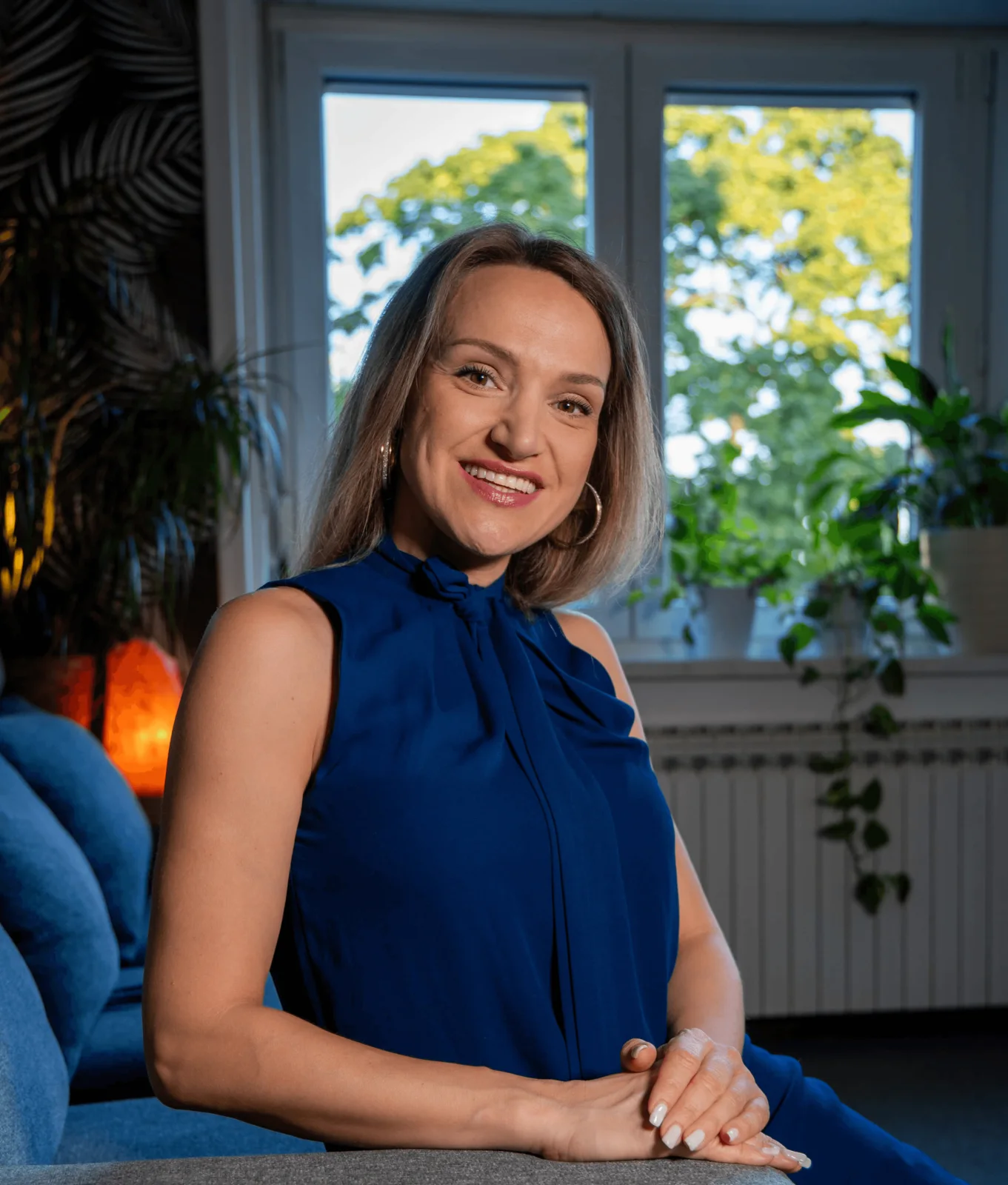
Petra Pinjuh
A coach, hypnotherapist and educator who works openly and professionally with relationships, intimacy and personal change.
More about Petra →